How Four-Roll Plate Bending Improves Accuracy and Repeatability
Quick Answer: A four roll plate bending machine improves accuracy and repeatability by holding the plate under control for the whole forming cycle. The plate stays clamped between the upper and lower rolls while the side rolls adjust, so both ends can be prebent and the body rolled without taking the plate out, flipping it, and loading it again. Fewer handling steps mean fewer places for the plate to shift, and programmable roll positions mean a setup that worked on the first part can be repeated on the twentieth. The machine does not remove material variation, so grade, thickness, and tolerance still need to be on the drawing.
You order twelve cylinder shells for a tank line, all drawn to the same inside diameter. The first three roll up cleanly and fit the mating heads. The fourth comes back slightly open at the seam, the ends show a flat spot where the plate was never fully formed, and your welders spend an afternoon forcing fit up that should have taken minutes. Six months later you reorder, and the new shells do not quite match the old ones.
Nothing about that story means the shop was careless. It usually means the process had too many variables that depended on handling and operator judgment from one part to the next.
Four roll plate bending exists to take most of those variables out of the loop. This article explains how the machine configuration controls the plate, where it improves accuracy and repeatability, and what it still leaves to your drawing and your material.
What Accuracy and Repeatability Mean on a Rolled Part
The two words get used interchangeably, but they describe different problems, and a rolling order can fail on either one.
Accuracy is how close the finished part comes to the drawing. On a rolled cylinder that means the inside diameter or radius, how round the shape is, how well the seam edges meet, and how little flat remains at the leading and trailing ends.
Repeatability is whether part twenty matches part one, and whether a repeat order matches the first order. Fit up on an assembly depends on repeatability as much as on accuracy, because a set of shells that each land slightly differently still creates gaps at the weld joints.
Why both matter to the buyer. A part that is accurate once but not repeatable forces rework every time the order recurs. A part that is repeatable but slightly off the drawing at least lets the shop correct the setup once and then hold it. Good rolling needs both.
How a Four Roll Machine Controls the Plate
The configuration is what separates it from other plate rolls. In a four roll machine, the top roll stays in a fixed position, the center bottom roll moves up and down to clamp the plate, and the two side rolls move in an arc toward and away from the top roll to set the bend.
The hydraulic HAEUSLER four roll machine uses linearly adjustable side rolls. During forming, the plate stays securely clamped between the upper and lower rolls, which reduces unnecessary handling and improves control during alignment, prebending, and rolling.
Clamped Means Held
A plate held firmly between two rolls cannot shift like one resting on supports, allowing the machine to maintain position during forming.
Side Rolls Set The Curve
Independently moving side rolls adjust the bend progressively throughout the forming cycle, allowing controlled curvature without releasing the plate.
The Same Geometry Every Time
Controlled roll movements replace manual repositioning, helping fabrication shops reproduce consistent forming geometry accurately across repeated production runs.
Prebending Both Ends Without Flipping the Plate
Every plate roll has the same basic limitation. The rolls need somewhere to grip the material when bending starts, which leaves an unbent flat section near the leading and trailing edges. If that flat is not eliminated by prebending, the finished cylinder shows a flat spot at the seam, and the shell never closes into a true circle.
What A Three Roll Setup Asks Of The Operator
On many three roll machines, the top roll cannot reach the plate's very end, requiring separate prebending. Operators feed one edge, remove the plate, flip it, and feed the opposite edge. Initial pinch machines also require rotating the plate 180 degrees after the first prebend.
What A Four Roll Setup Changes
A four roll arrangement can prebend both ends within one setup, eliminating the need to remove, flip, or reinsert the plate. Each avoided handling step reduces opportunities for shifting, misalignment, and inconsistent positioning during the forming process.
Why That Shows Up In Repeatability
When prebends differ between ends or production runs, finished shells may close with noticeable steps or gaps. Completing both prebends in one continuous setup helps maintain matching end geometry, producing more consistent closures across repeated parts.
Tip: When you send drawings for any rolled cylinder that will be welded at the seam, note the seam fit up requirement and whether flat spots at the ends are acceptable. A shop that knows the seam has to close tight can plan the prebend length accordingly.
Keeping the Plate Square While It Forms
A plate that enters the machine even slightly skewed will roll with a skew built into it. The cylinder comes out with a twist, a mismatch between the two edges, or a cone where a straight cylinder was drawn.
Squaring Against The Rolls
The plate stays square to the rolls before forming, while clamping helps prevent drifting during movement.
Two Driven Rolls
The HAEUSLER machine uses two driven rolls with automatic speed compensation, maintaining steady plate movement as forming geometry changes.
Less Hand Correction
Stable plate positioning reduces mid-cycle adjustments, helping operators minimize handling errors and improve consistency between formed parts.
Material handling still matters. A crane or lift to place and support the plate squarely is part of a clean rolling setup, especially on large or thin cylinders that can lose their shape under their own weight as they close.
Programmable Control and the Repeat Order
Repeatability on a reorder depends on being able to return to the settings that produced a good part. Four roll machines are programmable, and the HAEUSLER BENDtronic control system on our incoming machine is built for that kind of controlled forming.
Stored Positions Beat Memory
Recording roll positions lets operators restart future jobs from proven settings instead of repeatedly recalculating diameters.
First Article, Then Production
Operators form and measure an initial part, adjust settings, then save the corrected setup for consistent production.
Cylinders, Segments, And Cones
The machine forms full cylinders, cylinder segments, and continuous cones, maintaining consistency as roll positions change throughout each pass.
What Four Roll Bending Does Not Fix
Better equipment narrows the variation that comes from the process. It does not erase the variation that comes from the material, and an honest conversation about accuracy has to include that.
Material Properties Have A Tolerance
A plate certified to a grade and thickness still carries a tolerance in thickness, yield strength, and tensile strength. Two plates from different heats can spring back differently and elongate differently during rolling.
Roll Crown Fits A Range
Rolls are crowned to compensate for deflection over a range of thicknesses. Outside that range, the radius in the middle of the part can differ from the radius at the ends.
Capacity Depends On The Job
The machine's nominal full width rounding capacity is 55 mm, about 2.17 inches, under specified mild steel conditions, with plate widths up to approximately 10 feet. Actual capacity varies with material grade, yield strength, plate width, thickness, desired diameter, forming method, and tolerance requirements, so every project is reviewed against its drawing and specification.
Warning: Do not assume a four roll machine will hold the same finished diameter across plates from different heats or suppliers. Give the shop the material grade, thickness, and required tolerance up front, and tell them if a repeat order will be cut from different stock.
Where Four Roll Accuracy Pays Off Most
Some parts benefit more than others from the controlled, repeatable process described above.
Cylinders And Cylinder Segments
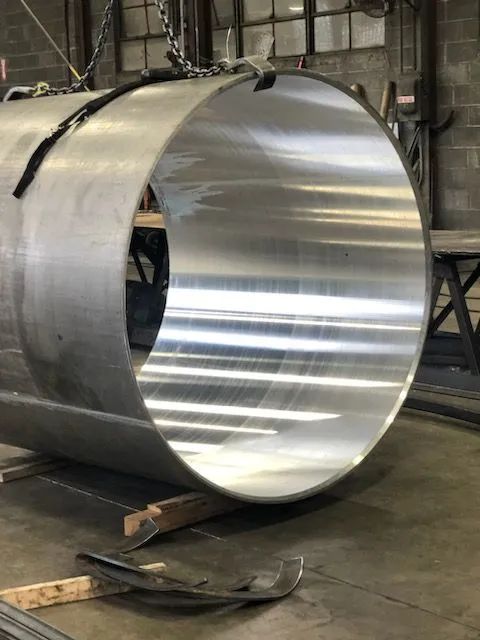
Tank shells, vessel components, and pipe sections require closed seams and accurately matched ends for proper assembly.
Cones And Transitions
Continuous cone bending requires steady roll movement throughout forming, making four-roll machines suitable for maintaining consistent geometry.
Welded Cylinder Calibration
Welded cylinders can be recalibrated on the same machine to restore roundness and achieve the required diameter.
Buckets And Earthmoving Components
High-volume production of curved plate components benefits from consistent forming, ensuring each finished part matches previous pieces.
Repeat And Production Orders
Repeat orders benefit from consistent shell dimensions, helping ensure reliable fit-up whenever components must match during assembly.
What to Send With Your Drawing
The more complete the information, the more accurately a shop can plan the forming approach. These are the details to include with a plate rolling request:
Material Type And Grade
Mild steel, stainless, or another alloy, with the grade called out.
Plate Thickness, Width, And Length
The dimensions of the flat plate before forming.
Desired Inside Diameter Or Radius
State whether the dimension is inside or outside.
Form Needed
Full cylinder, segment, cone, or calibration of a welded part.
Quantity And Required Tolerance
How many, and how tightly the finished dimension has to hold.
Requested Completion Date
Scheduling affects how the work is sequenced.
Frequently Asked Questions
Is four roll plate bending always more accurate than three roll bending?
Not automatically, since material, operator skill, and setup also matter. A four roll machine does offer tighter control, because the plate stays clamped and both ends are prebent without flipping.
Does a four roll machine eliminate flat spots at the plate ends?
It makes them far easier to control. Prebending both ends in one setup minimizes the flat near the edges, though thickness, material, and diameter still affect what remains.
Can a repeat order match the first order exactly?
Documented settings and a corrected setup make repeat orders far more consistent. A different heat or supplier can still shift springback, so tell the shop when stock changes.
What types of parts can a four roll machine form?
Full cylinders, cylinder segments, cones, tank and vessel shells, pipe sections, buckets, and other curved plate parts built from your drawings. It can also calibrate welded cylindrical components.
How wide and how thick a plate can be rolled?
The incoming HAEUSLER machine handles plate up to approximately 10 feet wide, with a nominal full width rounding capacity of 55 mm, about 2.17 inches, in specified mild steel conditions.
What information helps a shop quote a rolled plate job accurately?
Send the material grade, thickness, plate width and length, inside diameter or radius, form needed, quantity, tolerance, and required date. These details let the shop choose the right forming approach before cutting steel.
Controlled Rolling That Holds Up From Part One
Harvey Brothers Inc.
brings 100
years of steel rolling experience to its Cincinnati, OH shop, and that background shapes how each job is reviewed against its drawing and material grade before forming begins. Knowing how plate behaves from one heat to the next makes it easier to plan the prebend, set the rolls, and hold a corrected setup across a full run. The result is parts that fit their mating pieces, welds that go together without forcing, and a process that stays steady from one order to the next.